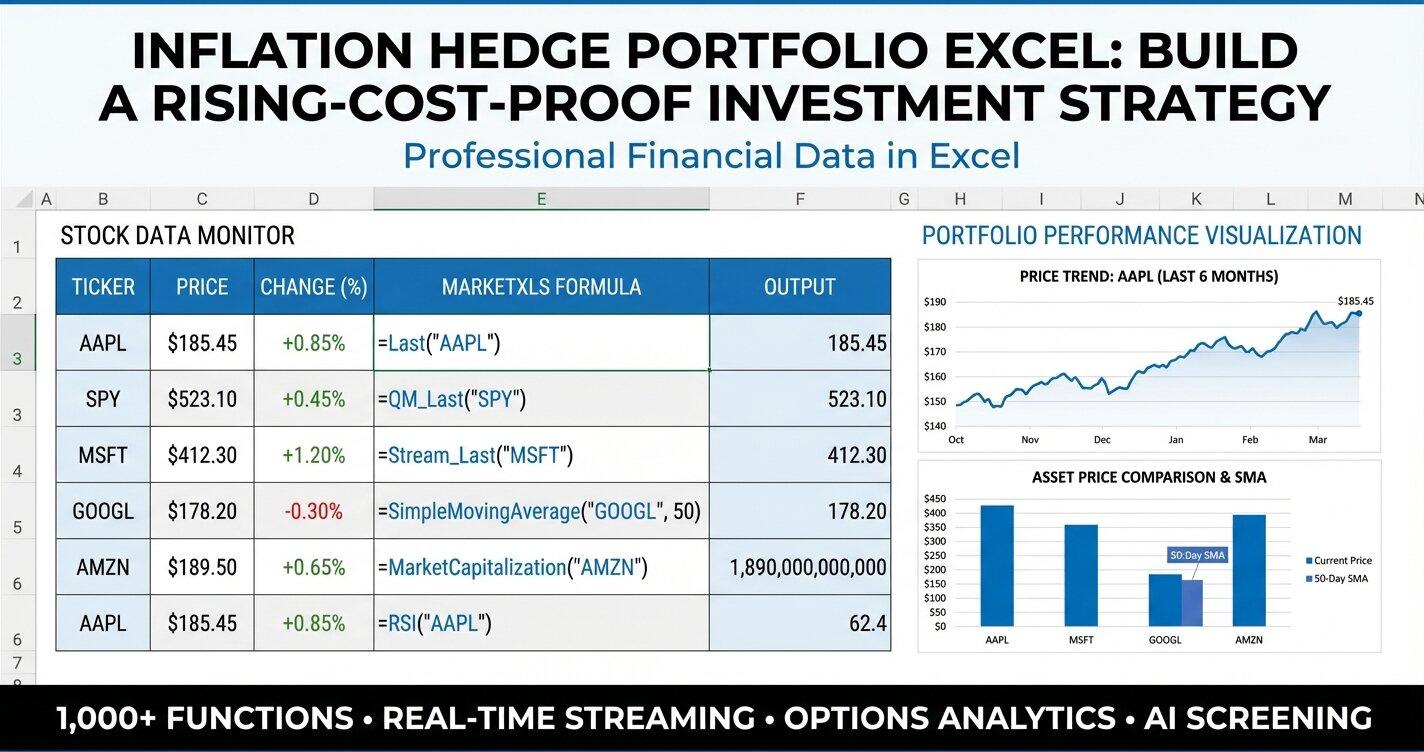
Inflation hedge portfolio Excel is what every serious investor needs when rising costs start eating into real returns — and March 2026 is exactly that kind of environment. With oil prices climbing past multi-year highs, energy costs rippling through supply chains, and the Consumer Price Index showing persistent above-target readings, the question is no longer whether to hedge against inflation but how to do it systematically.
This guide walks you through building a comprehensive inflation hedge portfolio tracker in Excel, complete with real-time data feeds, scenario analysis across five inflation levels, strategy comparisons, and position sizing logic. You will get two downloadable templates — one pre-filled with static data for immediate review, and one loaded with live MarketXLS formulas that update automatically. By the end, you will have a repeatable framework for positioning a portfolio against rising costs using ten carefully selected ETFs spanning TIPS, gold, energy, real estate, agriculture, commodities, dividend stocks, and utilities.
Inflation Hedge Asset Comparison — Key Data at a Glance
Before diving into methodology, here is a snapshot of the ten ETFs this template tracks, along with their inflation-hedging characteristics:
| Ticker | Name | Hedge Score (1-10) | Dividend Yield | Beta | Expense Ratio |
|---|---|---|---|---|---|
| TIPS | iShares TIPS Bond ETF | 9 | 4.52% | 0.15 | 0.19% |
| GLD | SPDR Gold Shares | 8 | 0.00% | 0.05 | 0.40% |
| XLE | Energy Select Sector SPDR | 7 | 3.28% | 1.12 | 0.09% |
| VNQ | Vanguard Real Estate ETF | 7 | 3.95% | 0.92 | 0.12% |
| DBA | Invesco DB Agriculture Fund | 7 | 1.15% | 0.35 | 0.91% |
| PDBC | Invesco Optimum Yield Diversified Commodity | 8 | 2.85% | 0.48 | 0.59% |
| SCHD | Schwab U.S. Dividend Equity ETF | 6 | 3.42% | 0.78 | 0.06% |
| XLU | Utilities Select Sector SPDR | 6 | 2.98% | 0.55 | 0.09% |
| BND | Vanguard Total Bond Market ETF | 3 | 3.65% | 0.10 | 0.03% |
| SPY | SPDR S&P 500 ETF Trust | 4 | 1.28% | 1.00 | 0.09% |
The hedge score is a composite metric that weighs historical CPI correlation, real return preservation, and income generation during inflationary periods. A score of 9 or 10 indicates a direct inflation linkage (like TIPS), while a 3 or 4 suggests the asset may actually lose real value during sustained inflation.
Why Inflation Hedging Matters Right Now
March 2026 presents a convergence of inflationary pressures that make portfolio protection more relevant than it has been in years. Three forces are driving this urgency.
Rising Energy Costs
Oil prices have been climbing steadily as global demand outpaces supply additions. Energy is a foundational input cost — when crude rises, everything from transportation to manufacturing to food production gets more expensive. The Energy Select Sector SPDR (XLE) has returned over 12% in the trailing twelve months, reflecting this dynamic. But energy prices do not just affect energy stocks; they cascade through the entire economy, pushing headline inflation higher and eroding the purchasing power of cash and fixed-income holdings.
Persistent Above-Target Inflation
Central banks have been battling inflation for years, and while progress has been made from the peaks, readings remain stubbornly above the 2% target in many developed economies. The Federal Reserve faces a delicate balancing act: cut rates too aggressively and risk reigniting inflation; hold rates too high and risk economic slowdown. This uncertainty creates an environment where both scenarios — continued inflation and potential stagflation — argue for some degree of inflation protection in portfolios.
Broad Market Uncertainty
Equity markets in early 2026 have shown increased volatility as investors digest mixed economic signals. Earnings growth has been solid in some sectors but disappointing in others. Geopolitical tensions continue to create supply chain disruptions. In this environment, a portfolio that relies entirely on traditional stock and bond allocations may be leaving significant risk unaddressed.
Understanding Inflation Hedge Asset Classes
Not all inflation hedges work the same way. Understanding the mechanism behind each asset class helps you build a more intelligent portfolio. Here is how each category functions as an inflation hedge.
Treasury Inflation-Protected Securities (TIPS)
TIPS are the most direct inflation hedge available to retail investors. The principal value of a TIPS bond adjusts with the Consumer Price Index, meaning that as inflation rises, both the principal and interest payments increase. The iShares TIPS Bond ETF (TIPS) provides exposure to a broad basket of these securities. The key metric to watch is the breakeven inflation rate — the difference between nominal Treasury yields and TIPS real yields. When breakeven rates are below your inflation expectation, TIPS may be undervalued as a hedge.
Gold and Precious Metals
Gold has served as a store of value for thousands of years, and it tends to perform well during periods of monetary uncertainty and currency debasement. The SPDR Gold Shares ETF (GLD) tracks the price of physical gold. Gold does not generate income (no dividends), which is a consideration for income-focused investors, but its low correlation with other asset classes makes it a powerful diversifier. In the current environment of rising energy costs and geopolitical uncertainty, gold has been attracting significant inflows.
Energy Sector
The Energy Select Sector SPDR (XLE) provides direct exposure to oil, natural gas, and energy services companies. When inflation is driven by rising energy costs — as it is in March 2026 — energy stocks tend to benefit directly. These companies see their revenues and profits rise alongside the commodity prices that are causing inflation. The beta of 1.12 means XLE is more volatile than the broad market, but that volatility is often to the upside during inflationary periods.
Real Estate Investment Trusts (REITs)
Real estate has historically been considered an inflation hedge because property values and rental income tend to rise with inflation. The Vanguard Real Estate ETF (VNQ) provides exposure to a diversified portfolio of REITs. However, the relationship between REITs and inflation is nuanced — rising interest rates (which often accompany inflation) can pressure REIT valuations because REITs compete with bonds for income-seeking investors. The best environment for REITs as an inflation hedge is moderate inflation with stable or declining interest rates.
Agriculture and Commodities
Agricultural commodities (DBA) and broad commodity baskets (PDBC) provide direct exposure to the raw materials whose prices often drive inflation. When food prices rise, DBA benefits. When energy and industrial metals prices rise, PDBC benefits. These are among the most responsive inflation hedges because they are inflation itself — CPI measures the prices of goods, and commodity ETFs hold those goods or their derivatives. The main risk is contango in futures markets, which can erode returns over time even if spot prices rise.
Dividend-Growth Stocks and Utilities
Companies with strong pricing power and growing dividends (SCHD) can serve as partial inflation hedges because they can pass rising costs to customers. Utilities (XLU) offer regulated pricing that often includes inflation adjustments. However, these are indirect hedges — they work best in moderate inflation environments and can struggle when inflation rises sharply enough to trigger aggressive rate hikes.
Building a Systematic Inflation Hedge Portfolio in Excel
A spreadsheet-based approach to inflation hedging offers several advantages over ad hoc portfolio construction. It forces you to quantify your assumptions, test scenarios, and maintain discipline through rebalancing rules. Here is the framework this template implements.
The Input-Driven Approach
The template starts with three user inputs that drive all downstream calculations:
- Portfolio Size — the total dollar amount you are allocating to inflation protection
- Risk Tolerance (1-10) — affects how aggressively the portfolio tilts toward volatile but high-protection assets
- Inflation Expectation (%) — your forward-looking view on inflation, which shifts allocation emphasis
These inputs sit in yellow-highlighted cells on the Dashboard sheet and propagate through every other sheet in the workbook. Change your portfolio size from $100,000 to $500,000, and every position size, dividend estimate, and dollar amount updates automatically.
Composite Hedge Scoring
Each ETF receives an Inflation Hedge Score from 1 to 10 based on three factors:
- Historical CPI Correlation — how closely the asset's returns track changes in the Consumer Price Index
- Real Return Preservation — the asset's ability to deliver positive returns after subtracting inflation
- Income Generation — dividend or interest payments that provide a cash flow cushion against rising costs
TIPS scores highest (9) because it has direct CPI linkage. BND scores lowest (3) because nominal bonds lose value in real terms when inflation exceeds their yield. The scoring is educational and based on historical patterns — actual future performance may differ.
MarketXLS Implementation — Real-Time Formulas
The template version of this workbook uses MarketXLS formulas to pull live market data directly into Excel. Here are the key formulas and how they are used:
Price and Market Data
=Last("TIPS")
The Last function returns the most recent traded price for any ticker. This is used across the Dashboard and Portfolio Allocation sheets to show current prices and calculate position sizes.
=Beta("XLE")
The Beta function returns the beta coefficient, measuring how much an asset moves relative to the broad market. This is critical for understanding portfolio-level risk. XLE's beta of approximately 1.12 means it amplifies market moves, while GLD's beta near 0.05 means it moves largely independently.
Dividend and Income Data
=DividendYield("SCHD")
The DividendYield function returns the trailing twelve-month dividend yield as a percentage. For income-focused inflation hedging, this tells you how much cash flow each position generates relative to its price.
=DividendPerShare("VNQ")
The DividendPerShare function returns the annual dividend payment per share. When combined with the number of shares in your position, this calculates your actual dollar income — a key metric for determining whether your portfolio generates enough cash to offset inflationary cost increases.
=DividendYield("TIPS")
The DividendYield function returns the annual dividend yield as a percentage. This matters for cash flow planning, helping you compare the income potential of different inflation hedge assets relative to their price.
Technical and Analytical Data
=SimpleMovingAverage("GLD", 200)
The SimpleMovingAverage function with a 200-day lookback period helps identify long-term trends. When gold is trading above its 200-day SMA, the uptrend is intact. This can inform entry and exit timing for the gold allocation within an inflation hedge portfolio.
=RelativeStrengthIndex("XLE", 14)
The RelativeStrengthIndex function calculates the 14-day RSI, which ranges from 0 to 100. Readings above 70 suggest overbought conditions; below 30 suggests oversold. For energy stocks, which can be volatile, RSI helps avoid adding to positions at extreme prices.
=MarketCapitalization("SPY")
The MarketCapitalization function returns the total market value. For ETFs, this reflects fund size and liquidity — larger funds generally have tighter bid-ask spreads and lower trading costs.
Fundamental Ratios
=ReturnOnEquity("XLE")
For equity-based holdings like XLE, SCHD, and XLU, the ReturnOnEquity function measures profitability. Companies with high ROE tend to have stronger pricing power, which is exactly what you want in an inflation hedge — the ability to pass rising costs to customers.
=TotalDebtToEquity("VNQ")
The TotalDebtToEquity function is especially important for REITs, which use significant leverage. High debt levels become more costly as interest rates rise alongside inflation, potentially undermining the inflation hedge thesis for heavily leveraged REITs.
=EarningsPerShare("SCHD")
The EarningsPerShare function shows profitability on a per-share basis. Growing EPS in an inflationary environment confirms that a company is successfully passing costs through to customers.
Template Walkthrough — Six Sheets Explained
Sheet 1: How To Use
The instructions sheet provides an overview of the workbook, explains the difference between the sample (static data) and template (live formulas) versions, and includes links to MarketXLS and the demo booking page. It also includes a disclaimer noting that all content is educational in nature.
Sheet 2: Inflation Hedge Dashboard
This is the command center. Three yellow input cells at the top — Portfolio Size, Risk Tolerance, and Inflation Expectation — drive calculations across the entire workbook. Below the inputs, a table displays all ten ETFs with current prices, year-to-date and one-year returns, beta, dividend yield, expense ratio, and the composite Inflation Hedge Score.
In the template version, the Price, Beta, and Dividend Yield columns are populated by MarketXLS formulas:
=Last("TIPS")       → Current price
=Beta("TIPS")       → Beta coefficient
=DividendYield("TIPS")  → Trailing yield
The sample version shows the same data frozen as of 2026-03-22 for users who want to explore the structure before installing MarketXLS.
Sheet 3: Scenario Analysis
The scenario sheet answers the critical question: "What happens to my portfolio if inflation hits X%?" It models five scenarios — 2%, 4%, 6%, 8%, and 10% inflation — and shows the expected return impact on each asset class.
Key observations from the scenario table:
- TIPS returns scale nearly linearly with inflation, confirming their role as a direct hedge
- Gold and commodities show accelerating returns at higher inflation levels
- Bonds (BND) show increasingly negative returns as inflation rises, confirming they are the most inflation-vulnerable asset
- Equities (SPY) are modestly positive at low inflation but sharply negative at high inflation
- Real estate (VNQ) follows a similar pattern to equities but with more sensitivity to rate hikes
Below the impact table, a suggested allocation emphasis section shows how portfolio weights might shift across scenarios — more TIPS and commodities at higher inflation expectations, less equities and bonds. These are educational illustrations, not prescriptive recommendations.
Sheet 4: Strategy Comparison
Four distinct inflation hedge strategies are compared side by side:
- TIPS-Heavy — 40% TIPS, 20% bonds, 10% gold, plus equities and real estate. Lowest volatility, most direct CPI protection, but limited upside.
- Commodity-Heavy — 25% PDBC, 20% XLE, 15% DBA, 15% GLD. Highest volatility but strongest returns in commodity supercycle scenarios. Requires active management due to contango risk.
- Dividend-Growth — 30% SCHD, 20% XLU, 15% VNQ. Moderate volatility with steady income. Works best in moderate inflation with strong corporate earnings.
- Balanced — 15% TIPS, 12% GLD, 12% SCHD, 10% XLE, 10% PDBC, and smaller positions across the rest. Diversified approach that works across multiple scenarios but may lag focused strategies.
Each strategy includes expected yield ranges, historical volatility bands, CPI correlation estimates, and entry/exit considerations. The comparison helps you select an approach that matches your inflation outlook, risk tolerance, and income needs.
Sheet 5: Portfolio Allocation
This is where the analysis becomes actionable. The allocation sheet takes the Portfolio Size input from the Dashboard and applies suggested allocation percentages to calculate:
- Dollar Amount per holding (Portfolio Size × Allocation %)
- Estimated Shares (Dollar Amount ÷ Current Price)
- Annual Dividend Income per position (DividendPerShare × Shares)
- Rebalancing Triggers (±5% deviation from target allocation)
In the template version, the formulas reference the Dashboard inputs dynamically:
=\'Inflation Hedge Dashboard\'!B3 * C6   → Dollar allocation for row 6
=INT(D6 / Last("TIPS"))                  → Estimated shares
=DividendPerShare("TIPS") * F6           → Annual dividend income
A totals row at the bottom sums all allocations and dividend income, giving you a quick view of your total portfolio and expected annual income from dividends.
Sheet 6: Correlation Matrix
The correlation matrix is the portfolio construction quality check. It shows the pairwise correlation between all ten holdings, color-coded for quick interpretation:
- Green cells (correlation ≤ 0.20) indicate low correlation — these pairs provide genuine diversification
- Red cells (correlation ≥ 0.60) indicate high correlation — holding both provides limited diversification benefit
- Blue diagonal marks the self-correlation (always 1.00)
Key insights highlighted below the matrix:
- GLD has low correlation with most assets, making it one of the best diversifiers
- TIPS and BND are highly correlated (0.85), so holding both adds redundancy
- XLE and PDBC share high correlation (0.65), as both track energy and commodity prices
- SCHD and SPY correlate at 0.75, meaning dividend stocks largely mirror the broad market
These insights should inform allocation decisions — if you hold significant XLE, you may want less PDBC, and vice versa.
Download the Templates
Two versions are available for download:
Static Sample Version — Pre-filled with data as of March 22, 2026. No add-ins required. Use this to explore the structure, review the scenario analysis, and understand the portfolio framework.
MarketXLS Formula Version — Contains live formulas that update automatically with real-time market data. Requires the MarketXLS add-in for Excel.
Both files include all six sheets: How To Use, Inflation Hedge Dashboard, Scenario Analysis, Strategy Comparison, Portfolio Allocation, and Correlation Matrix.
How to Use These Templates Effectively
Getting Started with the Sample Version
- Download the sample file and open it in Excel or Google Sheets
- Review the Dashboard to understand the ten ETFs and their hedge scores
- Explore the Scenario Analysis to see how different inflation levels affect returns
- Compare strategies on the Strategy Comparison sheet
- Check the Correlation Matrix to understand diversification dynamics
Upgrading to Live Data
- Install the MarketXLS add-in from marketxls.com
- Download the template version
- The formulas will automatically connect to live market data
- Modify the yellow input cells (Portfolio Size, Risk Tolerance, Inflation Expectation) to match your situation
- The entire workbook recalculates with your inputs and current market prices
Ongoing Portfolio Management
- Weekly review: Check the Dashboard for price changes and yield movements
- Monthly review: Run through the Scenario Analysis with updated inflation expectations
- Quarterly review: Compare your actual allocations against targets and rebalance if any position drifts more than 5% from its target weight
- Annual review: Reassess the overall strategy selection based on the evolving inflation outlook
Frequently Asked Questions
What is the best inflation hedge for a portfolio?
There is no single best inflation hedge — the optimal approach depends on the type of inflation, your time horizon, and risk tolerance. TIPS provide the most direct CPI protection with low volatility. Gold and commodities offer higher potential returns during severe inflation but with more volatility. A diversified approach using multiple asset classes tends to provide the most robust protection across different inflation scenarios. The template's Scenario Analysis sheet helps you evaluate which assets perform best under your specific inflation expectation.
How do I protect my portfolio from inflation in Excel?
Start by building a systematic tracking system. The templates provided in this article give you a complete framework: a dashboard for monitoring inflation-sensitive assets, scenario analysis for stress-testing your portfolio, and position sizing logic that adjusts to your portfolio size and risk tolerance. The key is using real-time data (via MarketXLS formulas) to keep your analysis current and making rebalancing decisions based on predefined triggers rather than emotion.
Can Excel track inflation hedge ETFs in real time?
Yes, with the MarketXLS add-in for Excel. Functions like =Last("TIPS") pull current prices, =DividendYield("SCHD") tracks income metrics, and =Beta("XLE") monitors risk characteristics — all updating automatically within your spreadsheet. This eliminates the need to manually look up prices or copy data from financial websites. The template version of our workbook uses these formulas throughout.
What ETFs are best for hedging inflation?
The most commonly used inflation hedge ETFs include TIPS (iShares TIPS Bond ETF) for direct CPI linkage, GLD (SPDR Gold Shares) for precious metals exposure, XLE (Energy Select Sector SPDR) for energy sector participation, PDBC (Invesco Optimum Yield Diversified Commodity) for broad commodity exposure, and DBA (Invesco DB Agriculture Fund) for food price inflation. Each has a different risk-return profile and correlation to inflation, which is why a diversified approach using multiple ETFs is generally more robust than concentrating in a single hedge.
How often should I rebalance an inflation hedge portfolio?
A quarterly rebalancing cadence works well for most investors, with a ±5% drift threshold as a rebalancing trigger. If any single position drifts more than 5 percentage points from its target allocation, consider rebalancing even before the quarterly date. Commodity-heavy strategies may benefit from monthly monitoring due to higher volatility and contango effects. The Portfolio Allocation sheet in the template includes rebalancing trigger levels for each position.
Does a 60/40 portfolio protect against inflation?
A traditional 60/40 stock-bond portfolio provides limited inflation protection. Bonds — which make up 40% of the portfolio — typically lose value in real terms during inflationary periods because their fixed coupon payments buy less as prices rise. Stocks can be partial inflation hedges if companies pass costs to consumers, but rising interest rates (which often accompany inflation) can pressure equity valuations. The analysis in this template shows that replacing some bond exposure with TIPS, commodities, or gold can meaningfully improve inflation protection without dramatically changing the portfolio's risk profile.
The Bottom Line
Building an inflation hedge portfolio in Excel gives you the transparency, customization, and analytical rigor that pre-packaged solutions cannot match. The templates provided here cover the full workflow — from monitoring ten inflation-sensitive ETFs on a real-time dashboard, to stress-testing your portfolio across five inflation scenarios, to comparing four distinct hedging strategies, to sizing positions and tracking correlations.
The current environment of rising energy costs and persistent above-target inflation makes this kind of systematic approach more valuable than ever. Rather than reacting emotionally to each inflation report or energy price spike, you can evaluate proposed changes against a quantified framework that accounts for correlations, yield, volatility, and your personal risk tolerance.
For live data integration that keeps your inflation hedge analysis current without manual updates, explore the MarketXLS add-in at marketxls.com. You can also book a demo to see how real-time formulas like =Last(), =DividendYield(), and =Beta() work within Excel to power inflation-aware portfolio management.
All analysis presented in this article is educational in nature and does not constitute investment advice. Past performance of inflation hedge assets does not guarantee future results. Always conduct your own research and consider consulting a qualified financial advisor before making investment decisions.