

The right options broker depends on how you trade. For high-volume traders, Interactive Brokers' tiered pricing (from $0.15 per contract on IBKR Pro) is usually cheapest. For multi-leg strategy tools and education, Charles Schwab's thinkorswim and Tastytrade stand out. For small, simple trades, Robinhood and Webull charge $0 per contract but route orders for payment for order flow. This guide compares 10 brokers on per-contract fees, platform, research, execution, and education as of the 2026 publish date; fees change often, so confirm current pricing on each broker's site before opening an account.
Selecting the right broker is one of the most important decisions an options trader can make. Unlike stock trading, where execution differences between brokers are relatively minor, options trading involves complex multi-leg orders, wider bid-ask spreads, and time-sensitive execution that can significantly impact profitability. A broker that offers excellent stock trading may fall short on options capabilities.
Options Trading Brokers: Quick Comparison Table
Side-by-side comparison of the 10 brokers:
| Broker | Per-Contract Fee | Platform | Best For | Mobile App | Research | Options Education |
|---|---|---|---|---|---|---|
| Interactive Brokers | $0.15-$0.65 | TWS / Client Portal | Active and professional traders | Strong | Extensive | Advanced |
| Charles Schwab | $0.65 | thinkorswim | All skill levels | Strong | Extensive | Excellent |
| E*TRADE | $0.50-$0.65 | Power E*TRADE | Active traders | Strong | Strong | Good |
| Fidelity | $0.65 | Active Trader Pro | Value-focused traders | Strong | Strong | Good |
| Tastytrade | $1.00 (capped) | Tastytrade Platform | Options-first traders | Good | Strong | Excellent |
| Robinhood | $0 | Robinhood App | Beginners | Primary | Basic | Basic |
| Webull | $0 | Webull Desktop and App | Tech-savvy beginners | Primary | Moderate | Moderate |
| Ally Invest | $0.50 | Ally Invest Live | Cost-conscious traders | Good | Moderate | Good |
| TradeStation | $0.60 | TradeStation Desktop | Technical traders | Good | Strong | Good |
| Merrill Edge | $0.65 | MarketPro | Bank of America customers | Good | Strong | Good |
Key Factors for Evaluating Options Trading Brokers
Six criteria separate options brokers:
Commission Structure
Options commissions have two components: the base commission (now $0 at most brokers) and the per-contract fee. While the difference between $0 and $0.65 per contract may seem small on a single trade, it compounds significantly for active traders. A trader executing 100 contracts per month at $0.65 per contract pays $780 annually in per-contract fees alone.
Beyond standard commissions, watch for:
- Exercise and assignment fees - some brokers charge $0 to $20 per event
- Index options pricing - often higher than equity options
- Volume discounts - available at brokers like Interactive Brokers for high-volume traders
- Closing transaction fees - some brokers waive fees on closing trades for certain contract sizes
Platform Capabilities
The trading platform is where you spend most of your time, so it must support your workflow efficiently:
- Options chain display - clean, customizable views with sortable Greeks are essential
- Strategy builders - visual tools for constructing multi-leg strategies like iron condors, butterflies, and calendar spreads
- Risk graphs - profit and loss diagrams that show potential outcomes at various price points and expiration dates
- Paper trading - the ability to practice strategies without risking real capital
- Order types - support for limit, stop, trailing stop, and conditional orders specifically designed for options
Execution Quality
Options execution quality matters more than stock execution quality because options have wider bid-ask spreads. A broker that consistently fills orders near the midpoint rather than at the ask can save active traders hundreds or thousands of dollars annually.
Payment for order flow (PFOF) is a consideration - brokers like Robinhood and Webull receive PFOF, which may impact execution quality. Brokers like Interactive Brokers offer direct market access that may result in better fills for larger orders.
Research and Analysis Tools
Quality options research tools include:
- Implied volatility data - IV rank, IV percentile, and historical IV charts
- Options screeners - filters by Greeks, volume, open interest, and unusual activity
- Probability analysis - probability of profit and expected move calculations
- Earnings calendars - critical for timing options around earnings events
Customer Support
Options trading can involve complex situations - assignment notifications, exercise decisions, margin calls on spreads. Having access to knowledgeable support representatives who understand options is valuable, especially for newer traders.
Education Resources
The best brokers provide structured options education including courses, webinars, strategy tutorials, and paper trading capabilities.
Top 10 Options Trading Brokers: Detailed Reviews
1. Interactive Brokers
Interactive Brokers ranks first here for its combination of low per-contract costs, a wide range of tradable assets, and a professional-grade platform.
Commission structure: IBKR Lite offers $0 base commission with $0.65 per contract. IBKR Pro offers $0 base with $0.15 to $0.65 per contract on a tiered structure based on volume, making it the most cost-effective option for active traders.
Platform highlights:
- Trader Workstation (TWS) provides institutional-grade options analytics including volatility surfaces, probability calculations, and comprehensive risk management tools
- The Client Portal offers a simplified web-based interface for traders who find TWS complex
- Options strategy builder supports virtually every multi-leg combination with visual P/L graphs
- Real-time risk management tools show portfolio Greeks, margin impact, and stress test results
Research and tools: Interactive Brokers offers extensive third-party research integration, options analytics from IVolatility, and sophisticated scanning tools for unusual options activity.
Best for: Active and professional options traders who want the lowest possible per-contract costs combined with institutional-quality tools. High-volume traders benefit most from the tiered pricing structure.
Considerations: The TWS platform has a steep learning curve. Beginners may find the Client Portal more approachable, though it lacks some advanced features.
2. Charles Schwab (including thinkorswim)
Following the TD Ameritrade acquisition, Charles Schwab now offers the thinkorswim platform, which is known for its options analysis and strategy tools.
Commission structure: $0 base commission, $0.65 per contract for equity options. Index options may carry additional exchange fees.
Platform highlights:
- thinkorswim provides industry-leading charting, options analysis, and strategy building tools
- The Analyze tab lets traders model complex multi-leg positions with detailed P/L projections across different price and time scenarios
- thinkScript allows traders to create custom studies and alerts
- Paper trading functionality (paperMoney) lets traders practice without risk
Research and tools: Schwab combines its own research with third-party reports such as Morningstar. The options-specific tools include IV percentile rankings, probability cones, and Greeks overlays on charts.
Education: Schwab's educational content is among the best in the industry, with structured courses covering options basics through advanced strategies, live webinars, and in-person seminars.
Best for: Options traders at all levels who want a combination of a powerful platform, excellent education, and comprehensive research. The thinkorswim platform particularly excels for traders who build complex multi-leg strategies.
3. E*TRADE (Morgan Stanley)
ETRADE, now part of Morgan Stanley, offers two distinct platforms that cater to different trader profiles, with Power ETRADE specifically designed for active options traders.
Commission structure: $0 base commission, $0.65 per contract standard, with a reduced $0.50 per contract for active traders who execute 30 or more trades per quarter.
Platform highlights:
- Power E*TRADE features an intuitive options chain interface with strategy-specific views
- The platform includes a snapshot analysis tool that provides quick probability and risk assessments for option strategies
- Live Bloomberg TV integration keeps traders informed of breaking news while they trade
- The risk and reward visualizer clearly displays potential outcomes for multi-leg strategies
Research and tools: Access to Morgan Stanley research, combined with E*TRADE's own options analysis tools, provides a strong analytical foundation.
Best for: Active options traders who appreciate an intuitive interface and want the volume discount at 30 trades per quarter. The Power E*TRADE platform strikes a good balance between sophistication and usability.
4. Fidelity
Fidelity takes a value-driven approach to options trading, combining competitive pricing with strong research and exceptional customer service.
Commission structure: $0 base commission, $0.65 per contract. Fidelity is transparent about execution quality and regularly publishes its price improvement statistics.
Platform highlights:
- Active Trader Pro provides a desktop platform with real-time streaming data, advanced charting, and options-specific tools
- The Probability Calculator helps traders assess the likelihood of various outcomes
- Options strategy evaluation tools display Greeks, breakeven points, and maximum profit/loss
- The directed trading feature lets experienced traders route orders to specific exchanges
Research and tools: Fidelity offers extensive equity research from its in-house team plus third-party providers. Options-specific tools include screeners for unusual activity and IV analysis.
Customer service: Fidelity consistently ranks among the highest for customer satisfaction, offering 24/7 phone support with representatives who understand options trading.
Best for: Options traders who value a combination of competitive pricing, strong research, and excellent customer support. Particularly suitable for those who also maintain retirement accounts and want everything under one roof.
5. Tastytrade
Tastytrade is the only broker on this list built from the ground up specifically for options and futures traders. Founded by Tom Sosnoff (co-founder of thinkorswim), the platform reflects decades of options trading experience.
Commission structure: $0 base commission, $1.00 per contract to open (with a cap on multi-leg orders). Closing trades are commission-free. This structure benefits traders who trade multi-leg strategies with many contracts.
Platform highlights:
- The curve analysis view shows the entire options chain organized by probability, Greeks, and volatility metrics
- Follow mode lets traders replicate strategies from the tastylive network
- The portfolio beta-weighted delta display helps traders understand their overall directional exposure
- Trade management tools highlight positions approaching milestones (percentage of max profit, days to expiration)
Research and tools: Tastytrade integrates with tastylive, a financial network focused entirely on options education and strategy discussion. This gives traders access to ongoing educational content directly within the platform.
Best for: Options-focused traders who want a platform designed specifically for options strategies. The free-to-close pricing structure benefits traders who actively manage and adjust positions.
6. Robinhood
Robinhood disrupted the brokerage industry with its zero-commission model and continues to attract new options traders with its simple, mobile-first approach.
Commission structure: $0 per trade, $0 per contract. Truly commission-free options trading.
Platform highlights:
- The mobile app provides a clean, intuitive interface for viewing options chains and placing orders
- Basic strategy building supports single-leg trades and some multi-leg combinations
- Simple P/L displays show breakeven points and maximum outcomes
- The web platform has expanded capabilities compared to the mobile app
Considerations: Robinhood receives payment for order flow, which may impact execution quality on larger orders. The platform lacks advanced analytics like IV rank, probability analysis, and comprehensive Greeks displays. Options approval levels are more restricted than at full-service brokers.
Best for: Beginning options traders who want to start with simple strategies at zero cost. As traders develop more sophisticated strategies, they typically migrate to platforms with more advanced tools.
7. Webull
Webull offers commission-free options trading with a more data-rich experience than Robinhood, targeting tech-savvy traders who want analytical tools without per-contract fees.
Commission structure: $0 per trade, $0 per contract.
Platform highlights:
- Real-time market data including options chains with Greeks displays
- Advanced charting capabilities with technical indicators
- Paper trading for practicing strategies without risk
- A desktop platform that provides more screen real estate for options analysis than the mobile app
Research and tools: Webull provides more analytical tools than Robinhood, including basic options flow data and volume analysis.
Best for: Tech-savvy beginning to intermediate traders who want zero-commission options trading with better analytical tools than Robinhood.
8. Ally Invest
Ally Invest combines competitive options pricing with the convenience of integrated banking through Ally Bank.
Commission structure: $0 base commission, $0.50 per contract - one of the lowest per-contract rates among full-service brokers.
Platform highlights:
- Ally Invest Live provides a browser-based platform with options chain views, strategy builders, and profit/loss calculators
- The Probability Calculator displays the likelihood of an option expiring in, at, or out of the money
- Streaming real-time data and customizable options chain layouts
- Integration with Ally Bank accounts for easy fund transfers
Best for: Cost-conscious options traders who want a full-service platform at one of the lowest per-contract rates, especially those who already bank with Ally.
9. TradeStation
TradeStation has long been a favorite of technical traders, and its options capabilities leverage the same powerful analytical engine that drives its stock and futures platforms.
Commission structure: $0 base commission, $0.60 per contract for equity options, $1.00 per contract for index options.
Platform highlights:
- The desktop platform handles complex trading strategies with advanced order types
- EasyLanguage programming lets traders build custom indicators, strategies, and screeners
- RadarScreen provides real-time scanning of options metrics across large watchlists
- OptionStation Pro offers detailed options analytics including theoretical pricing models
Research and tools: TradeStation's strength is in custom analysis. Traders who can write EasyLanguage code have virtually unlimited analytical capabilities.
Best for: Technical and quantitative options traders who want the ability to build custom analytical tools and automated screening criteria.
10. Merrill Edge
Merrill Edge provides a solid options trading experience enhanced by seamless integration with Bank of America accounts and access to Merrill's research.
Commission structure: $0 base commission, $0.65 per contract.
Platform highlights:
- MarketPro provides a web-based platform with options chain views, strategy evaluation, and real-time data
- Integration with Bank of America allows instant transfers and consolidated account views
- Preferred Rewards program provides benefits based on combined banking and investment balances
- Access to Bank of America and Merrill Lynch research
Best for: Bank of America customers who want integrated banking and investing with solid options capabilities, and traders who value access to institutional-quality research from Merrill Lynch.
How MarketXLS Complements Any Options Broker
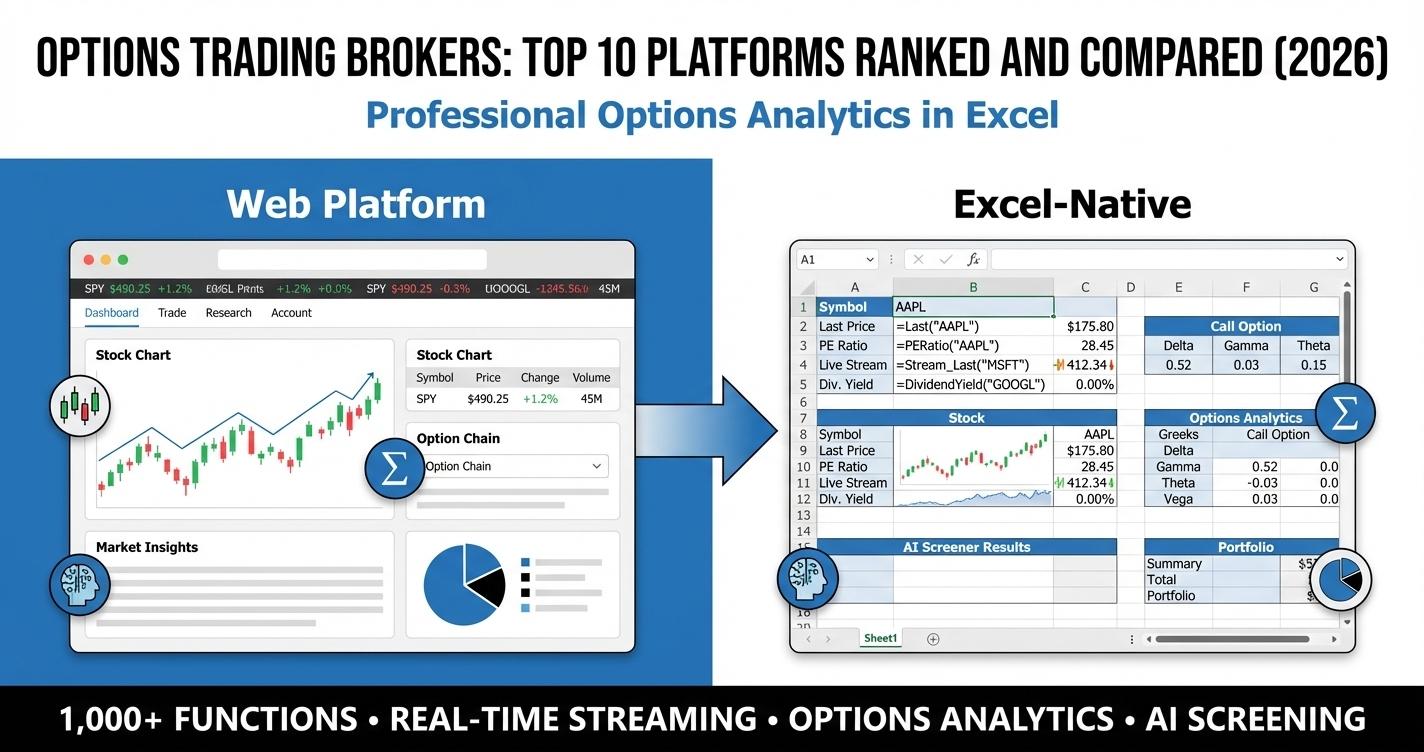
MarketXLS is an Excel add-in for analysis, not a broker: it pulls option chains, quotes, and Greeks into Excel, and you place trades with your broker. Options data is end-of-day on the Standard plan and real-time streaming on the Advanced and Business plans. Here is how it works alongside a broker:
Pull Live Option Chains
Use =QM_GETOPTIONCHAIN("AAPL") to pull the complete option chain for any stock into your spreadsheet. This gives you access to all strikes, expirations, bids, asks, and Greeks without manually copying data from your broker.
Build Custom Option Symbols
The =OPTIONSYMBOL("AAPL","2026-06-20","C",190) function generates the standard option symbol format, which you can then use with other MarketXLS functions to pull specific option data.
Get Option Prices and Greeks
=QM_Last(option_symbol)               - Last trade price
=QM_Bid(option_symbol)                - Current bid
=QM_Ask(option_symbol)                - Current ask
=opt_Delta(stock_price, option_price, expiry, "Call", strike)   - Delta
=opt_Gamma(stock_price, option_price, expiry, "Call", strike)   - Gamma
=opt_Theta(stock_price, option_price, expiry, "Call", strike)   - Theta
=opt_Vega(stock_price, option_price, expiry, "Call", strike)    - Vega
=opt_ImpliedVolatility(stock_price, option_price, expiry, "Call", strike) - Implied volatility
Formula documentation: QM_Last, QM_Bid, QM_Ask, opt_Delta, opt_Gamma, opt_Theta, opt_Vega, opt_ImpliedVolatility
The opt_ Greek functions take the underlying price, the option's market price, the expiry date, the option type, and the strike.
Analyze Volatility and Market Sentiment
=IMPLIEDVOLATILITY30D("AAPL")         - 30-day implied volatility
=IVRANK1YEAR("AAPL")                  - IV rank over past year
=OPT_PUTCALLVOLRATIO("AAPL")          - Put/call volume ratio
=OPT_MAXPAIN("AAPL", "2026-06-19")    - Max pain strike for an expiration
=OPT_OPENINTEREST(option_symbol)      - Open interest
Formula documentation: IMPLIEDVOLATILITY30D, IVRANK1YEAR, OPT_PUTCALLVOLRATIO, OPT_MAXPAIN, OPT_OPENINTEREST
Create Reusable Strategy Templates
Build Excel templates that pull market data to evaluate strategies before placing trades through your broker:
- Enter a ticker symbol in a yellow input cell
- Formulas automatically pull the option chain, calculate Greeks, and display key metrics
- Model different strike selections and see projected P/L
- Once satisfied with your analysis, execute the trade on your broker's platform
Download the Sample Spreadsheet (static data):
Download the Live Template (requires MarketXLS):
These templates include a broker comparison dashboard, cost scenario analysis across different trading volumes, strategy-to-broker matching, and a portfolio trade tracker with live Greeks.
Choosing the Right Broker: Decision Framework
To help narrow your selection, consider which profile best matches your trading approach:
High-Volume Active Trader
If you execute more than 100 options contracts per month, commission costs are a primary concern. Interactive Brokers (IBKR Pro) offers the lowest per-contract rates for high volume. The savings compared to $0.65-per-contract brokers can reach thousands of dollars annually.
Strategy-Focused Trader
If you regularly trade iron condors, butterflies, calendar spreads, and other multi-leg strategies, platform capability matters most. Charles Schwab's thinkorswim and Tastytrade both excel at visualizing and executing complex strategies.
Beginning Options Trader
If you are new to options, prioritize education and simplicity. Charles Schwab offers the best combination of educational content and platform capability. Robinhood offers a zero-cost starting point, though you will likely outgrow it as your strategies become more sophisticated.
Research-Driven Trader
If your approach relies heavily on fundamental and technical research before entering options positions, Fidelity and Charles Schwab provide the deepest research libraries. Pair either with MarketXLS for additional quantitative analysis.
Cost-Minimization Priority
If keeping costs as low as possible is your top priority, Robinhood and Webull offer truly zero-cost options trading. Be aware of the trade-offs in execution quality and platform capability.
Frequently Asked Questions
Which options trading broker has the lowest fees?
Options trading brokers with the lowest fees include Robinhood and Webull, both offering $0 per-contract fees. Among full-service platforms, Ally Invest charges $0.50 per contract and Interactive Brokers offers tiered pricing starting at $0.15 per contract for high-volume traders. The "cheapest" broker depends on your trading volume - at low volumes, zero-commission brokers save the most; at high volumes, Interactive Brokers' tiered pricing typically wins.
Is Interactive Brokers good for beginner options traders?
Options trading brokers like Interactive Brokers have historically been considered more suitable for experienced traders due to the complexity of the TWS platform. However, their IBKR Lite plan and simplified Client Portal now make the platform more accessible to beginners. For true beginners, Charles Schwab (thinkorswim) provides better educational resources alongside its professional-grade platform, while Robinhood offers the simplest starting point.
Can I use MarketXLS with any options trading broker?
Options trading brokers handle execution, while MarketXLS works independently as an Excel add-in for analysis. MarketXLS is not tied to any specific broker - you can use it alongside Interactive Brokers, Charles Schwab, E*TRADE, or any other platform. Use MarketXLS to pull option chains with =QM_GETOPTIONCHAIN(), analyze Greeks, and build strategy models in Excel, then place trades through whatever broker you prefer.
What features should I prioritize when choosing an options trading broker?
Options trading brokers should be evaluated on five key factors: (1) per-contract fees and exercise/assignment charges, (2) platform quality including option chain displays, strategy builders, and risk graphs, (3) research tools including implied volatility data and options screeners, (4) educational resources and paper trading, and (5) customer support quality. Active traders should prioritize execution speed and order types, while beginners should focus on education and paper trading.
Are commission-free options trading brokers truly free?
Options trading brokers that advertise commission-free options trading (like Robinhood and Webull) genuinely charge $0 in commissions and per-contract fees. However, these brokers generate revenue through payment for order flow (PFOF), which means your orders may not receive the absolute best execution price. For small trades, commission savings typically outweigh any execution price differences. For larger trades or complex multi-leg strategies, brokers with better execution quality may save you more overall despite per-contract fees.
How do options trading brokers handle exercise and assignment?
Options trading brokers typically auto-exercise in-the-money options at expiration (usually $0.01 or more ITM). Assignment fees vary - most brokers listed here charge $0 for exercise and assignment, though some may charge up to $20. It is crucial to understand your broker's policies on early exercise, cash settlement for index options, and margin requirements for assigned positions. Always review your specific broker's fee schedule for these less common but important charges.
Conclusion
Whether you choose Interactive Brokers for its cost efficiency, Charles Schwab for its thinkorswim platform, or Robinhood for its zero-cost simplicity, the key is matching your broker's strengths to your trading style and experience level.
Regardless of which broker handles your execution, complement your trading with MarketXLS for deep Excel-based analysis. Use MarketXLS to pull option chains, calculate Greeks, track implied volatility, and build reusable strategy templates, then execute your trades on the platform that fits your needs. Real-time options data requires the Advanced or Business plan; see pricing details.
Related Resources: