

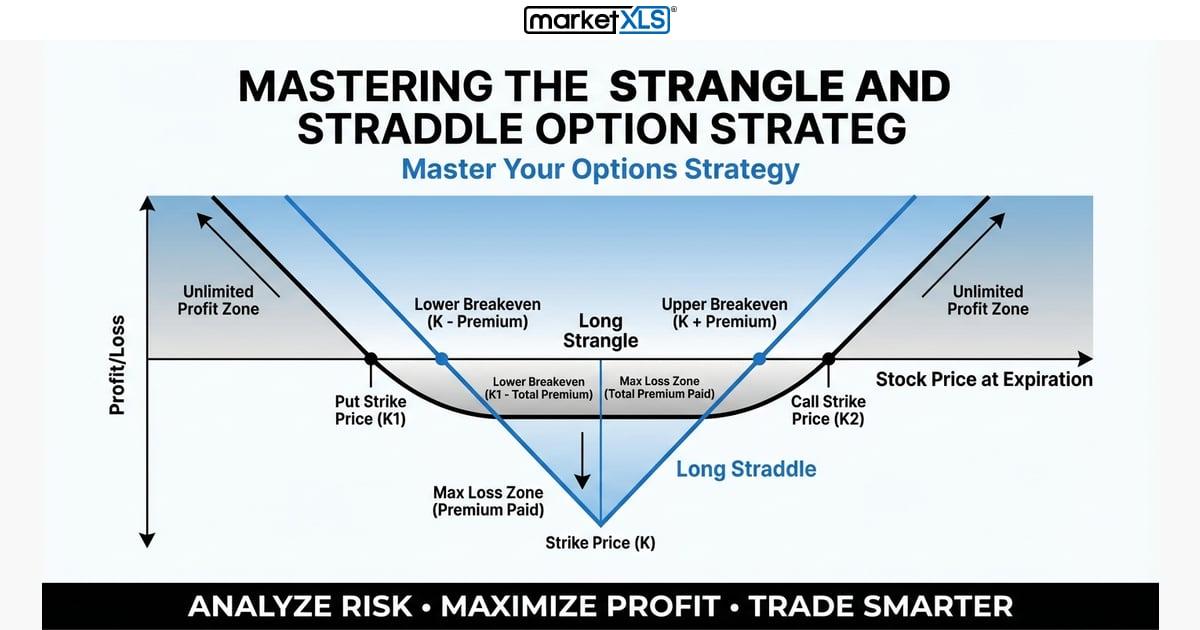
Mastering the Strangle and Straddle Option Strategies
A long straddle buys a call and a put at the same strike and expiration; a long strangle buys an out-of-the-money call and an out-of-the-money put at different strikes. Both profit if the stock makes a large move in either direction and lose (up to the total premium paid) if it stays near the strikes. A strangle costs less than a straddle but needs a bigger move to break even. Selling either structure reverses the payoff: you collect premium but face large losses on a big move.
What is Options Trading?
Options trading is an investment strategy that allows traders to speculate on the future movement of an underlying asset. This activity takes place through the purchase and sale of call and put contracts, and traders may use options for either hedging an existing stock portfolio against downside risk, or for leveraging up an existing strategy for increased profit and loss potential.
What are Strangle and Straddle Strategies?
Strangle and Straddle Strategies represent two of the most popular forms of options trading strategies. A Strangle strategy involves the purchase of a higher strike call option and a lower strike put option, whereas a Straddle strategy involves the purchase of the same strike call and put options. The strategies may also be applied in reverse, to create a ‘short’ position, by selling the call and put options.
Strangle and Straddle Strategies – Pros and Cons
Compared to other options trading strategies, a Strangle and Straddle approach offer several advantages. Both these strategies can easily be executed in short timeframes and are especially beneficial when there is an expectation of an upcoming market move. You do not need to predict the direction of the move, only its size.
On the downside, a long straddle or strangle loses money if the stock does not move enough to cover both premiums, and time decay works against the position every day. Implied volatility often falls after an expected event such as earnings, which can reduce the value of both options even after a move. Short straddles and strangles carry large, potentially unlimited losses on a big move. Moreover, unanticipated market events can also affect the strategy’s success.
MarketXLS: Making Option Strategies Easier.
MarketXLS is an Excel add-in that returns option chains, implied volatility, and Greeks as cell formulas, for example =QM_GetOptionChain("AAPL"), and provides option calculators for theoretical value. You can use it to price both legs of a straddle or strangle, compute breakevens, and plot the payoff with the options profit calculator. This is educational content, not investment advice.
Relevant blogs that you can read to learn more about the topic